watches

Revolutions in time

If you’re visiting Paris, a good place to see some interesting clocks is the Musée des arts et métiers.

In 1793, the Revolutionary Government in France decreed that the day should be divided into 10 hours of 100 minutes, and the year into 10 months of 30 days. For a few years, clock and watch makers designed some unusual pieces to help the population learn and adopt to the new decimal time system. Here’s a good example:

frenchrevo1.jpg

The single long hand with a circle at one end and a point at the other probably shows the hours in both old and new systems. One end points to the decimal time, with 10 (0) being midnight, and 5 being midday, the other end to the equivalent old-style time. Presumably, therefore, old-style midnight (XII) is at the bottom of the dial, so that the other end can point to 10 (0). 1 o’clock (decimal) is about 02:20 old style, and the position of the hour hand in this photograph suggests that the time is 0.90 (d), or 02:10 old style.

If the other brass hand is the new minute hand, it shows 80 decimal minutes past 0. In theory a time of 0.80 (d) corresponds with about 01:55, so perhaps the hands are not quite adjusted correctly – or my assumptions are incorrect.

The grey pointer indicates the calendar day – the 12th. Every day in the new Revolutionary calendar had a object or plant associated with it, so if the current month had been Pluviôse (Jan 20 ~ Feb 18), today would be Broccoli day. (For a full list, see here.)

Here’s a watch with, I expect, midnight at the bottom:

frenchrevo2.jpg

At about 3 o’clock (decimal), or 07:15, it’s time for croissants and café. Again it’s not clear whether the minute hand is showing old or new minutes.

This next example is more radical. Only half the dial is organized for the new decimal time, the other half is defiantly quadrovigesimal (duodecimal times two):  Presumably the long dual-purpose hour hand is used again here, but I’m puzzled as to why only the roman numerals I to V are used – converting to a new time format is hard enough without having to add 5 to the hour after midday. The shorter hand pointing to the 12 might be another old-style hour hand (how could it work?), but the other hand pointing to the 2 could be an old or new style minute hand. Some more research is needed.

frenchrevo3.jpg

Intriguingly, the museum shows only 10% of its holdings at a time, with the remaining items held in a big storage facility on the outskirts of Paris.

If you can’t get to this great museum in person – to see these and other wonderful scientific objects from the past (and to eat in the excellent cafe) – the museum’s web site is worth a look.
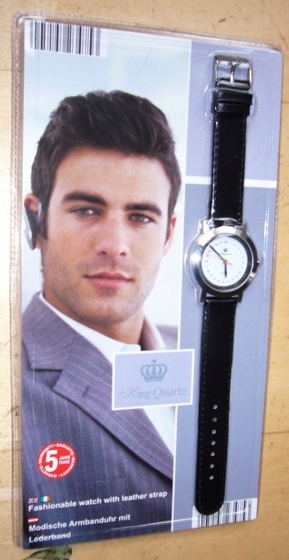
Hall of Shame: First award to Lidl supermarkets

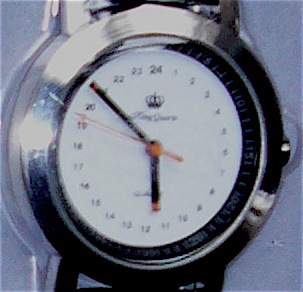
You might be surprised – and delighted – to see a 24 hour analog watch in your local supermarket while shopping. Here’s the watch in its original packaging, seen in supermarket chain Lidl this week. Looks like a bargain for just 2.99 pounds (4.5 Euros, or 6 US dollars)?

lidl1.jpg

On closer inspection it promises to be a nicely-designed yet very cheap quartz genuine 24 hour analog watch:

lidl2.jpg

But it turns out that these watches have a standard 12 hour movement. So after just one hour, the hour hand has advanced two hours. Time will really fly by!

Don’t be tempted.

New range of 24 hour watches

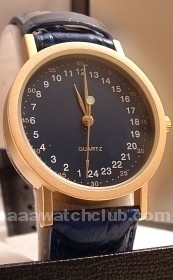
Those nice people at the AAA Watch Club have introduced new models in their popular 24 hour watch range. These now feature luminous numerals, and you can also have them with high quality leather straps as well as stainless steel straps.

aaawatch2005.jpg

Plus, there are now gents and ladies models, and you can get them with white dials too. Accuracy is as expected from a good quality quartz movement – mine has yet to lose a whole second since I started timing it last week. The high contrast display is working fine in this gloomy English winter, although luminous dots for the odd-numbered hours would be even better.

Radical designs

Here’s an amazing new look 24 hour analog watch, designed by Kent Parks at Everest Watches.

everest.jpg

The daylight hours are at the right side of the dial, and the nighttime hours are on the left side. It all glows in the dark, too!

I saw this on the WatchUSeek 24 hour watch forum. This is a great place to meet 24 hour watch enthusiasts and experts, and talk about 24 hour watches.

Another reason to show this watch here is that it illustrates the difference between the 24 hour dial and the 24 hour time format. The 24 hour dial shows all the hours of a day at once; the 24 hour time format (known outside the US as ISO 8601) uses the numbers 13 to 23 for afternoon and evening hours rather than AM and PM suffixes. This watch, like so many 24 hour clocks and watches from earlier centuries, uses a double-12 numbering system rather than the 24 hour time format.

Hummel watch

A finely finished and inexpensive quartz watch. Unusually, this company have chosen the noon at the top design:

hummel.jpg

Find this at mdmarketing.de, but you may need to translate the site from German if you’re not a deutschsprecher.

You can find this, and a definitive list of all true 24 hour analog watches, at André’s 24 hour watch site.

Day and Night

The Masterpiece Jour et Nuit is a clever design by Maurice Lacroix which uses a technique developed in the 18th century. The single hand carries moon and sun symbols, and goes round once a day. This makes for an elegant display, although it wouldn’t be popular with astronomical purists, being a good representation of the positions of the sun and moon only once a month, around the time of the full moon. There’s another example on the Design page of this site.

mauricelacroix.jpg

Elgin marvel

Claire writes to tell us about her new 24 hour watch, an Elgin dating from the 1940s.

elgin.jpg

She found it in a tiny watch repair shop in her town, after some time searching for a decent 24 hour analog watch.

Keep looking in those small watch and antique shops for collectable items like this!

Owners of Elgin watches are fortunate in being able to find out so much about the company’s history at Elgin watches.

Star time

I’ve been looking at the Zeitladen site and, being far from fluent in German, I can’t decide whether they’re selling standard 24 hour clocks and watches or sidereal (sternzeit or star time) versions.

If you watch a particular star and make a note of when it is highest in the sky (its transit time) on two successive days, you’ve measured a sidereal day. A sidereal day is about 23 hours and 56 minutes.

If you set two clocks, one showing sidereal time, the other 24 hour time, to tell the same time as each other, starting at September 22 or so (the Autumn equinox), the sidereal clock would run faster than a 24 hour clock, gaining 4 minutes in the course of every 24 hour day. After 6 months, the sidereal clock would be 12 hours faster. After a year, the sidereal clock would be exactly a day faster: there are 366 sidereal days in a year.

I presume that astronomers like to use sidereal clocks because it helps them locate stars.

Do they also use sidereal watches? Is this a sidereal watch?zeitladen1.jpg

What about this clock?

mira24a.jpg

I can’t decode the German text enough to find out.

Visually there seems to be no difference between the design of the 24 hour and sidereal dials. So you would be well advised to place one of these sidereal clocks next to an ordinary 24 hour clock, or else clearly label it as sidereal. As for watches, you could wear the sidereal watch on your right wrist, the ordinary 24 hour watch on the left…

I’ve had watches and clocks that seem to gain 4 minutes a day. Perhaps they were sidereal and I didn’t know it.

Zeitladen also sells radio-controlled sidereal clocks.

The Zeitladen site was interesting, particularly if your German was good!

The site is now closed, unfortunately.

Vostok watch

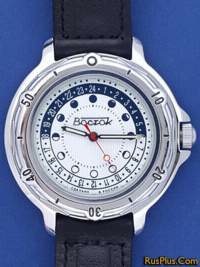
This Vostok watch is the Neil Armstrong version of the Cosmonaut watch.

vostokneilarmstrong.jpg

The Vostok factory have been making watches since the Great Patriotic War (what we call the Second World War), and were official suppliers to the Soviets during the Cold War period of the 1960s. It’s good to see them commemorating the first man on the moon. The Yuri Gagarin version doesn’t have a picture of the moon on it.

I saw this at rusplus.com, but you may find it elsewhere.