Star time

I’ve been looking at the Zeitladen site and, being far from fluent in German, I can’t decide whether they’re selling standard 24 hour clocks and watches or sidereal (sternzeit or star time) versions.

If you watch a particular star and make a note of when it is highest in the sky (its transit time) on two successive days, you’ve measured a sidereal day. A sidereal day is about 23 hours and 56 minutes.

If you set two clocks, one showing sidereal time, the other 24 hour time, to tell the same time as each other, starting at September 22 or so (the Autumn equinox), the sidereal clock would run faster than a 24 hour clock, gaining 4 minutes in the course of every 24 hour day. After 6 months, the sidereal clock would be 12 hours faster. After a year, the sidereal clock would be exactly a day faster: there are 366 sidereal days in a year.

I presume that astronomers like to use sidereal clocks because it helps them locate stars.

Do they also use sidereal watches? Is this a sidereal watch?zeitladen1.jpg

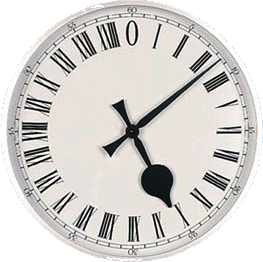
What about this clock?

mira24a.jpg

I can’t decode the German text enough to find out.

Visually there seems to be no difference between the design of the 24 hour and sidereal dials. So you would be well advised to place one of these sidereal clocks next to an ordinary 24 hour clock, or else clearly label it as sidereal. As for watches, you could wear the sidereal watch on your right wrist, the ordinary 24 hour watch on the left…

I’ve had watches and clocks that seem to gain 4 minutes a day. Perhaps they were sidereal and I didn’t know it.

Zeitladen also sells radio-controlled sidereal clocks.

The Zeitladen site was interesting, particularly if your German was good!

The site is now closed, unfortunately.
Jack’s bad day

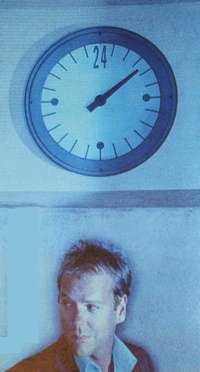
Here’s somebody who really needs a genuine 24 hour clock. This publicity photograph for the second series of TV show 24 (just started in the UK) shows a 24 analog clock measuring Jack Bauer’s bad day for him. It’s only 03:30 in the morning (by the 24 hour clock on the wall) and he looks tired already. (I don’t think this scene appears in the show – in fact I don’t think the show contains any references to 24 hour clocks or 24 hour time.)

jacksbadday.jpg jackballoon.png

Photo credit: Dan Winters (Radio Times magazine)

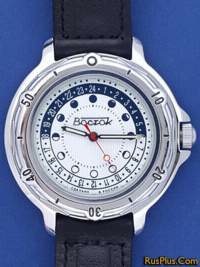
Vostok watch

This Vostok watch is the Neil Armstrong version of the Cosmonaut watch.

vostokneilarmstrong.jpg

The Vostok factory have been making watches since the Great Patriotic War (what we call the Second World War), and were official suppliers to the Soviets during the Cold War period of the 1960s. It’s good to see them commemorating the first man on the moon. The Yuri Gagarin version doesn’t have a picture of the moon on it.

I saw this at rusplus.com, but you may find it elsewhere.

Unusual two-handed clock

This is an unusual clock.

franklintwohourhands.gif

It’s got four hands. There are two hour hands, one red, one black. It will be particularly useful if you often need to know the time in two different parts of the world – perhaps the time in another office, or of a friend who lives abroad.

You can buy this 24 hour clock from Franklin Clocks.

It wouldn’t be as easy to do this with a 12 hour clock face. If, for example, the black hand was pointing to 8 on a 12 hour face, and the red hand pointed to 2, you couldn’t tell whether the red hand was 6 hours earlier than the black one or ahead of it.

There are interesting parallels between this clock and a few clocks that were built in the 19th century during the early days of the railway network’s rapid expansion. At Bristol Corn Exchange, for example, a clock with two minute hands was installed during the 1840s.

bristolclock.jpg

One hand indicated the time in London, the time that Brunel’s Great Western Railway kept. The other minute hand showed local time, 11 minutes slower, as kept by Bristolians.

Then, the concern was with the time kept in another town. Now, we’re interested in the time on the other side of the world.

Arlene’s clock

Arlene emailed me with details of a clock that she bought at an auction many years ago.

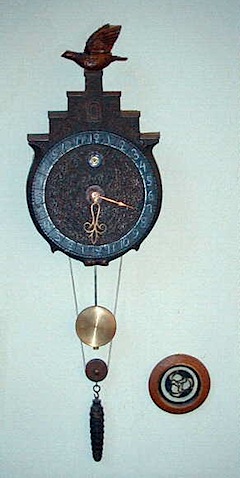
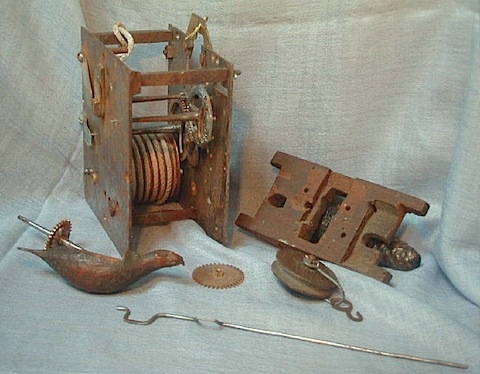
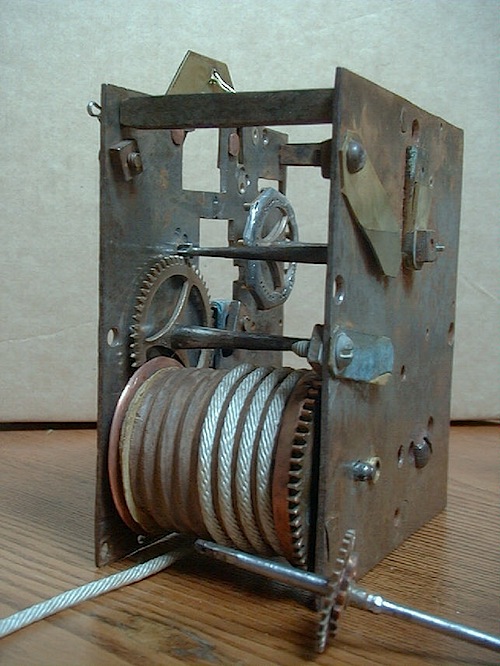
The box contained a carved wooden clock face and some parts. From the remaining parts, it appears to have been a weight driven wall clock. It has a 24 hour face with 12 at top and bottom and all numbers in Arabic numerals. A slim bodied bird (now minus its wings) on a wire appeared to have sat on top of the clock and may have been turned by some part of the mechanism. It was not however, a ‘cuckoo’ clock – the bird was large compared to the clock and did not leap out of the clock. The auctioneer said that the clock was a model of a European tower clock but did not remember which country or tower.

This is the clock before Arlene made some repairs.

arlenesclockface.jpg

arlenesclockoverview2.jpg

Here it is running, after some repairs. If you’ve seen this type of clock before, or know anything about them, please let us know!

arlenesclock.jpg

arlenesclockparts.jpg arlenesclockparts2.jpg