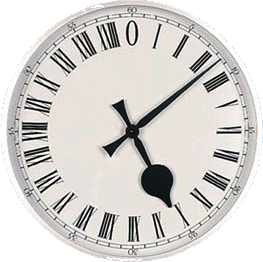
24 hour

Day and Night

The Masterpiece Jour et Nuit is a clever design by Maurice Lacroix which uses a technique developed in the 18th century. The single hand carries moon and sun symbols, and goes round once a day. This makes for an elegant display, although it wouldn’t be popular with astronomical purists, being a good representation of the positions of the sun and moon only once a month, around the time of the full moon. There’s another example on the Design page of this site.

mauricelacroix.jpg

12 at the top

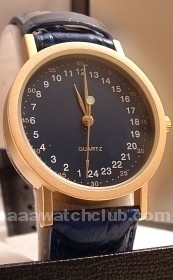
Those nice people at the AAA watch club have released a 24 hour watch with 12 at the top. There are some connoisseurs of the 24 hour analog dial who prefer the 12 at the top (it’s more often found at the bottom of the dial), but have found it difficult to find watches.

aaawatch12attop.jpg

Look no further!

Elgin marvel

Claire writes to tell us about her new 24 hour watch, an Elgin dating from the 1940s.

elgin.jpg

She found it in a tiny watch repair shop in her town, after some time searching for a decent 24 hour analog watch.

Keep looking in those small watch and antique shops for collectable items like this!

Owners of Elgin watches are fortunate in being able to find out so much about the company’s history at Elgin watches.

Konfabulator

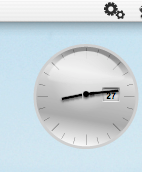
For my Mac I’ve created this 24 hour analog clock by adapting a cool 12 hour clock provided by the extremely cool Konfabulator.

konfabclock.png

The works of the clock consist of a short JavaScript program (Konfabulator provides a JavaScript engine to animate your creations). You can create a face for the clock using any graphics program – this was my first effort in Adobe Illustrator.

Swedish clocks

From Sweden, Sylvie emails to tell us about her work with 24 hour clocks:

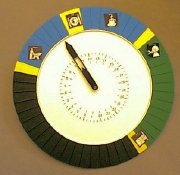
In Sweden we have been developing new ways for people with development disorder to handle their everyday activities. A very difficult field is to handle time. Time is hard to get a grip on when you are not able to think abstract or have trouble making a plan in your mind. It’s too many thinking activites involved at the same time. In Sweden we have developed several technical aids and some methods to help simplify handling time issues. One of these are 24 hour clocks.Unfortunately we do not have home sites in English that describe our work with this.

The best site to get to know what we are dealing with is www.pajalaklockan.com/. You can click below the clock icon on Tidshjalpmedel. Now there is a menu where you will find the Swedish word dygnsklocka which means 24 clock.

swedishdygnsklocka.jpeg

There are three models right now. The first one was developed in the northern region of Sweden where it hardly ever gets dark in the summer time. This created lots of trouble for people with thinking difficulties. A man who worked at a daycare center developed it to help some of his mates. Now they are selling it. It’s called Pajalaklockan after the village. It has plastic bits for every half hour that you can put messages, symbols on, and they come in different colours making it possible to mark the working hours in different colours from freetime and sleeping time.

Star time

I’ve been looking at the Zeitladen site and, being far from fluent in German, I can’t decide whether they’re selling standard 24 hour clocks and watches or sidereal (sternzeit or star time) versions.

If you watch a particular star and make a note of when it is highest in the sky (its transit time) on two successive days, you’ve measured a sidereal day. A sidereal day is about 23 hours and 56 minutes.

If you set two clocks, one showing sidereal time, the other 24 hour time, to tell the same time as each other, starting at September 22 or so (the Autumn equinox), the sidereal clock would run faster than a 24 hour clock, gaining 4 minutes in the course of every 24 hour day. After 6 months, the sidereal clock would be 12 hours faster. After a year, the sidereal clock would be exactly a day faster: there are 366 sidereal days in a year.

I presume that astronomers like to use sidereal clocks because it helps them locate stars.

Do they also use sidereal watches? Is this a sidereal watch?zeitladen1.jpg

What about this clock?

mira24a.jpg

I can’t decode the German text enough to find out.

Visually there seems to be no difference between the design of the 24 hour and sidereal dials. So you would be well advised to place one of these sidereal clocks next to an ordinary 24 hour clock, or else clearly label it as sidereal. As for watches, you could wear the sidereal watch on your right wrist, the ordinary 24 hour watch on the left…

I’ve had watches and clocks that seem to gain 4 minutes a day. Perhaps they were sidereal and I didn’t know it.

Zeitladen also sells radio-controlled sidereal clocks.

The Zeitladen site was interesting, particularly if your German was good!

The site is now closed, unfortunately.

Jack’s bad day

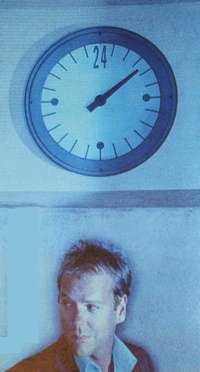
Here’s somebody who really needs a genuine 24 hour clock. This publicity photograph for the second series of TV show 24 (just started in the UK) shows a 24 analog clock measuring Jack Bauer’s bad day for him. It’s only 03:30 in the morning (by the 24 hour clock on the wall) and he looks tired already. (I don’t think this scene appears in the show – in fact I don’t think the show contains any references to 24 hour clocks or 24 hour time.)

jacksbadday.jpg jackballoon.png

Photo credit: Dan Winters (Radio Times magazine)

Vostok watch

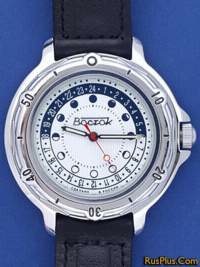
This Vostok watch is the Neil Armstrong version of the Cosmonaut watch.

vostokneilarmstrong.jpg

The Vostok factory have been making watches since the Great Patriotic War (what we call the Second World War), and were official suppliers to the Soviets during the Cold War period of the 1960s. It’s good to see them commemorating the first man on the moon. The Yuri Gagarin version doesn’t have a picture of the moon on it.

I saw this at rusplus.com, but you may find it elsewhere.

Unusual two-handed clock

This is an unusual clock.

franklintwohourhands.gif

It’s got four hands. There are two hour hands, one red, one black. It will be particularly useful if you often need to know the time in two different parts of the world – perhaps the time in another office, or of a friend who lives abroad.

You can buy this 24 hour clock from Franklin Clocks.

It wouldn’t be as easy to do this with a 12 hour clock face. If, for example, the black hand was pointing to 8 on a 12 hour face, and the red hand pointed to 2, you couldn’t tell whether the red hand was 6 hours earlier than the black one or ahead of it.

There are interesting parallels between this clock and a few clocks that were built in the 19th century during the early days of the railway network’s rapid expansion. At Bristol Corn Exchange, for example, a clock with two minute hands was installed during the 1840s.

bristolclock.jpg

One hand indicated the time in London, the time that Brunel’s Great Western Railway kept. The other minute hand showed local time, 11 minutes slower, as kept by Bristolians.

Then, the concern was with the time kept in another town. Now, we’re interested in the time on the other side of the world.