24 hour

Site move

I’ve just completed moving this site over to WordPress. If you’re reading this, we both made the move successfully. Apart from a few broken links, most of it appears to be OK. If anything isn’t working that should be, please let me know (there’s a Contact form on the Welcome page) .

onehandsaver.png

This is a picture of my current screensaver project – a one-handed design. I’m still undecided as to whether I like the diluted precision.

The sound of one hand ticking

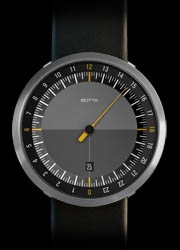
A new single-handed 24 hour watch:

uno_24_dunkel.jpg.jpeg

Here’s Klaus Botta on the philosophy of simplicity:

We live in a time of increasing complexity – the consequence of which is growing uncertainty and stress.A reduction in complexity and a focus on the bare essentials gives rise to a sense of security and calm. Coupled with the highly functional orientation of the product‘s stylistic vocabulary, this embodies the philosophy of Botta-Design, a philosophy which is particularly noticeable in our one-hand watches. Things become clearer and easier to comprehend when they are stripped down to the bare essentials

Prices start from 300 Euros. Visit Botta Design for details.

Cognitime’s DØGN watch

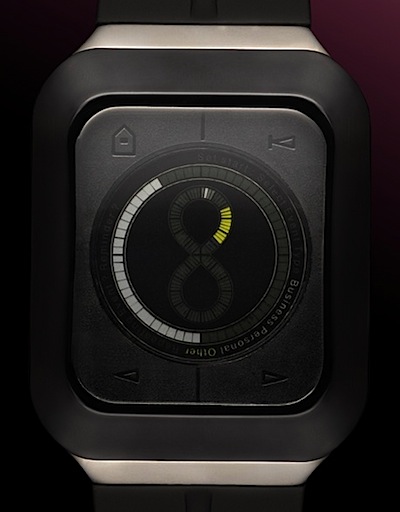
The new DØGN watch from Cognitime is certainly a thing of beauty:

COGN

It features an ingenious figure-of-eight display for the hours, surrounded by a circular minute dial. The segments light up according to the time: 12 noon and midnight meet in the center. The first 12 hours of the day are shown by an illuminated segment that marches counter-clockwise round the top circle, and the second 12 hours of the day marches round the lower circle.

It’s also got some scheduling and calendar features, but I haven’t been able to find out much about how these are supposed to work.

Where are the iPhone clocks?

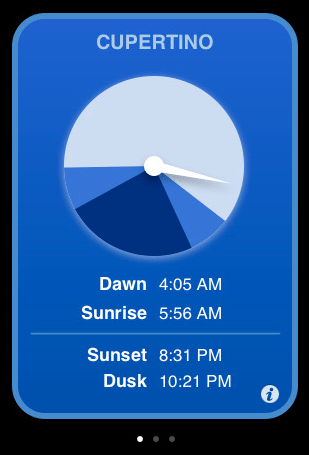
Native applications for the iPhone and the iPod Touch are arriving in droves at the iTunes App store. However, there are very few clock apps, and only one of interest to 24 hour clock fans. It’s called Sol, written by Alexander Valys, (web site http://sol.avalys.net/). It’s an elegant sun clock showing the rising and setting times of the sun for a number of locations, on a 24 hour dial (12 noon at the top, 24:00 at the bottom).

sol.png

iPhone clock

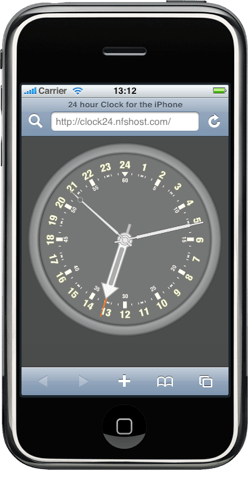
Here’s a software experiment: a time piece for the iPhone. It’s a ‘web app’, which means that it’s an ordinary web page that’s been designed specifically to work on an iPhone or iPod Touch. In fact, I suspect that it won’t work in any other browser apart from Safari. The artwork is mostly in PDF, for one thing.

iphone web app clock

If you have an iPhone (or an iPod Touch), please try this out, and let me know what you think!

Note that a single tap will rotate the dial so that 12 or 24 is at the top.

How to grow clocks

I stumbled across an interesting piece on YouTube recently. It has only a passing relevance to this site, but it was too cool to ignore. It’s from a contributor called cdk007, whose presentation is part video, part lecture, and part software demonstration. It explores an idea that was made famous by the Reverend William Paley, an 19th century English clergyman, who argued that, just as watches are too complicated to have arisen spontaneously and must have been fabricated by a watchmaker, so life on earth must have been made by an intelligent designer. The ‘blind watchmaker’ analogy has been explored both by evolutionists as an example of an illogical and fallacious argument in favour of some god-like creator figure, and by creationists as a – perhaps initially – plausible objection to evolution. Most famously, Richard Dawkins has persuasively argued the Darwinian side, pointing out, in his ‘Blind Watchmaker’, that the forces of natural selection can produce amazing complexity.

cdk007 isn’t content to just point out the illogicalities of the creationist argument, though. He goes one step further, and examines the argument using a software simulation. I love the way his collection of mating clocks with mutating genomes manage to enter ‘the age of pendulums’, before evolving further into four-handed clocks.

growclock1.png

The clocks grown by the simulation manage to evolve – you guessed – a 24 hour dial! Notice here the number of seconds on the left-most dial – 86,817 is close to the number of seconds in a 24 hour day.

growclock2.png

The video can be seen here.

Linear thinking

Recently I think there have been a few more different ways of showing time. Here’s a picture of the clock-setting interface on an iPhone:

iphone-clock-setting.jpg

The illusion of a circular wheel rotating is very strong, particularly when you flick it up and down with your finger – it speeds up and slows down like a well-oiled bicycle wheel. But the display is effectively a digital clock that’s also a linear analog clock.

Measuring time as a point along a line is probably as old as angular time measurement, if not older. Early sundials from Egypt show the length of the sun’s shadow being measured on a simple graduated stick, although angular displays are also common in the ancient world. Through history the passage of time has also been marked by a change of water level, a decrease in height of a marked candle, or a change in length of a trail of slow burning incense.

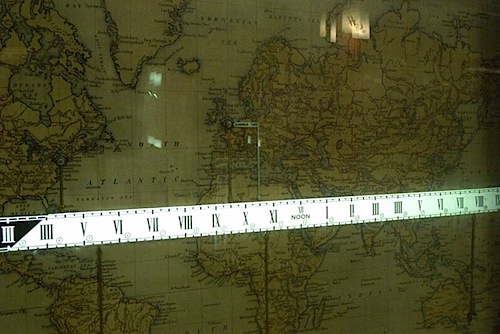
A striking linear clock can be seen in Picadilly Circus tube station in London. A metal band travels from east to west over a fixed Mercator map of the world, showing the mean solar time for any location. The band itself is a 24 hour indicator, but if you think about it, it’s clear it has to be 48 hours long (since it has to go round the back of the map).
picadilly.jpg

There are a number of software linear clocks around. Here’s an old one called Stripclock that I used to run on my Palm. (You can google for this but there’s no current url for the author, who might be called Fraser McCrossan) This was great because by tapping you could zoom in closer and closer onto the time display – either watch the seconds speed by or follow the imperceptible movement of the week or month.

palm-linear-clock.gif

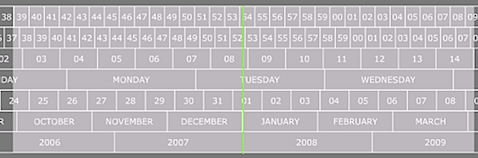
And here’s a more recent Flash version of the idea. Not zoomable, but compelling in a different way:
flash-linear.png

(The live Flash version is at http://home.tiscali.nl/annejan/swf/timeline.swf.) Unlike the iPhone controls, you don’t get the sense of any circularity in time. To the left – if you could scroll back far enough – is the formation of the universe; to the right, the heat death of the solar system…

Notice that this style of display has exactly the same ‘problem’ as circular analog clocks: it’s hard to show the various time units to any proportional scale. A second is as big as a minute, although they move to the left much faster. This is a great picture of time flowing like water under a bridge.