
This clock can be found at the corner of Rue du Faubourg Poissonière and Rue Bergère in Paris. I’ve not yet found anything out about it – if you have any information, please share!
Photograph by Flickr user paris2e.
This clock can be found at the corner of Rue du Faubourg Poissonière and Rue Bergère in Paris. I’ve not yet found anything out about it – if you have any information, please share!
Photograph by Flickr user paris2e.
This unusual clock in the old town of Klatovy appears to have been built in 1924. Thanks to Priit on Flickr for the photo.

Very unusual clock as it shows 24 hours
Originally uploaded by ph1310
This is the Willis World Clock in the London Science Museum.

I’ve not found out much about it, or who Willis was, but I did find a reference to a smaller versionin a 1939 copy of Flight magazine (here) and I presume the description is mostly valid for this version too:
The operation of this clock is extremely simple, with a twenty-four-hour moving disc in the centre and a separate minute hand below. The main face of the clock is laid out in sectors, with the names of all the more important countries and cities in the world indicated by arrows, and the time for each particular place is merely read cif against the appropriate arrow. The timing disc itself is clearly marked in a.m. and p.m. sections, so that, even when the twenty-four method of reading is not being used, there is no possibility of error. Those countries and cities where “summer time” arrangements are in force are printed separately in red type. For example, Great Britain and France have two positions, one at Greenwich time and one, for the summer season, on the mid-European time arrow.
Needless to say, such a clock will be useful in working out E.T.A.s which are likely to be at or near nightfall, and also for timing the reception of both weather broadcasts and others required for D/F bearings. The world clock is obtainable from J. H. Willis and Company, Ipswich Road, Norwich, and the aircraft or small marine type, for instrument-board mounting, is priced at 137s. 0d.
One of these – non-functioning, I think – was sold on eBay recently. You could have bought it for just £13.
This is a recent picture of the Zytglogge, the astronomical clock in Bern, Switzerland:

You can read a lot about it at Zytglogge – Wikipedia, the free encyclopedia.
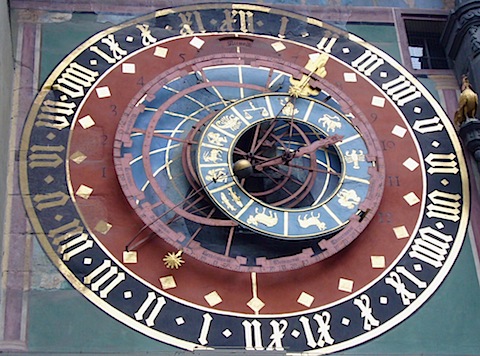
It’s hard to tell whether everything is working correctly. The picture was taken at 15:46 on Wednesday September 2. So the date seems right – the sun pointer at the bottom left is pointing to Herbstmonat 2, and the tiny window just below the top XII says Mittwoch. The other sun pointer in the zodiac ring is in the constellation of Virgo, which is also correct, I think. It’s only the time of day which I couldn’t easily find. That could be why there’s a simpler clock above it!

A few more 24 hour iPhone applications are appearing in the iTunes App Store. If you want to check any of these out, let me know how they work – I have no idea.
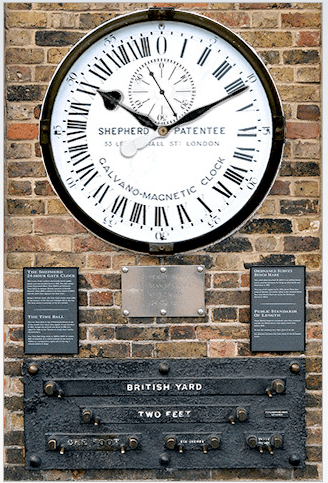
Here’s a familiar sight: the famous Shepherd Gate Clock at Greenwich, London. The Shepherd Gate Clock (this link is a link to the App Store) costs a modest dollar. I’m assuming that this is a genuine 24 hour analog clock. The time here is 20:10. It’s going to look a bit odd at midnight, with that sunlit brick wall…
This next one is a puzzle. It’s called iWatch, and it features an attractive rendering of three watches, including this Patek Phillippe watch with a 24 hour rotating dial. What looks like the hour hand is really the minute hand, and what looks like the minute hand is really the second hand. So the time on this picture is about 04:18:49.
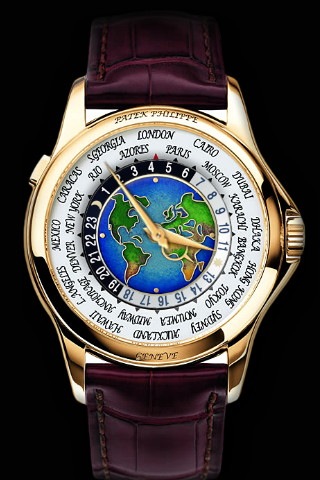
(I’m not a big fan of the design, to be honest. The map is coarse, and that font isn’t attractive.) The real puzzle, though, is why this app is suddenly no longer available on the App Store, now that I want to provide a link to it.
The next app, nHands Clock, is a useful clock that lets you add as many hours hands as you like, with colour and labels of your choice. It’s a clever way of showing you the different time zones of people you know:

Finally, this excellent app is called 25h:
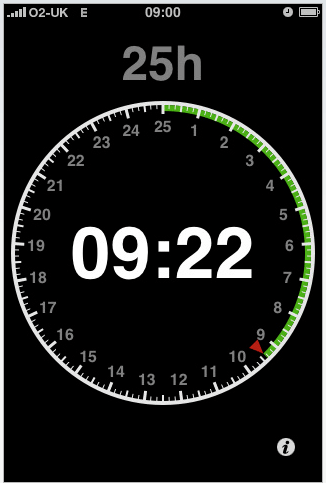
The idea is simple:
Feeling overstretched? 24 hours in a day is not enough? Then 25h is a clock for you.
Trick yourself into having 25 hours in a day. Get things done faster and have an extra “hour” for yourself.
Note that 25h does not modify time–space continuum (or your biological clock) to give you an extra hour. It simply makes the rest of your hours appear a little shorter so that enough time is saved for an additional shorter “hour” at the end of the day.
I know some people who set their watches fast – this is an interesting alternative.
For a fascinating introduction to the world of Russian 24 hour watches, visit the russian24hours.info site, where Andrei writes knowledgeably about their history and variety:
A 24 hour watch is not just about the expanse of a large country or technological achievements – it is about a different way of looking at both time and space.
Here’s an inexpensive and practical pocket watch that I bought recently from the Zenitar store at eBay, with Victor at Zenitar providing excellent service. It’s a mechanical Raketa. I know nothing about it, other than its price, a mere $35!
I had it modified to make the hands luminous: they’re usually given a simple reflective finish that renders them invisible in certain lighting conditions. With the new coating, the extra contrast makes the watch readable in most lights.
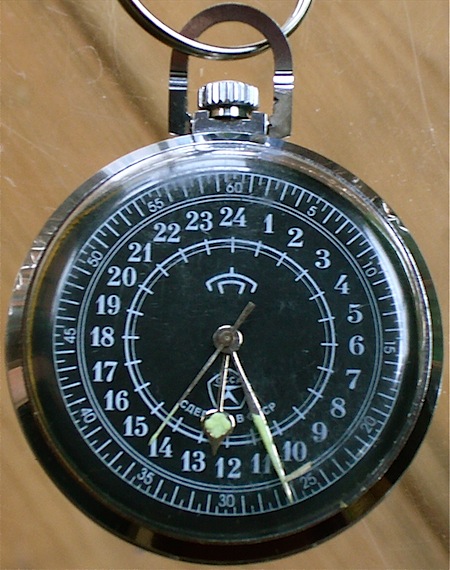
It’s starting to look at bit battered. I might have to buy another one every six months!
I like this idea of this clock. You can attach extra hands to it, to indicate the time for others living in different time zones.
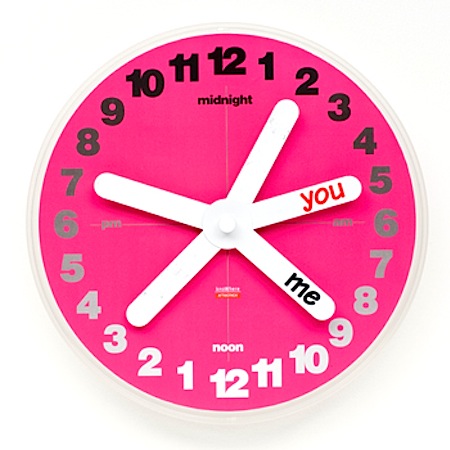
You can buy this from Wrapables.com for about $50. In Europe, try buying it from Charles and Marie.
This chronometer was probably used on a World War II USAAF bomber. Graham (on the Watchuseek forum) sold it recently through Bonhams of London.
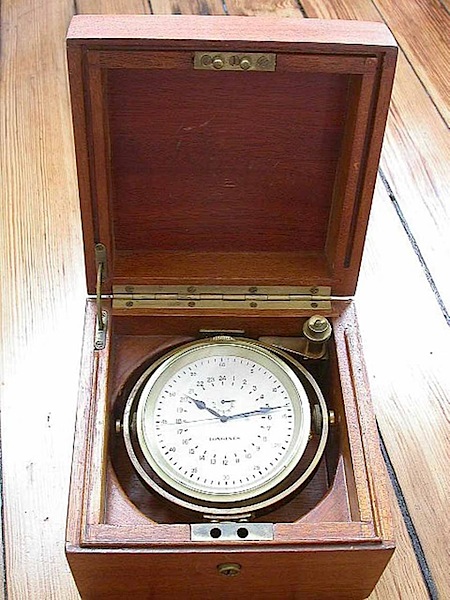

From the Airnautic Watch Company web site:
The guiding design philosophy of AirNautic® Watch Company is to separate day and night as the elemental parameters of the perception of time. The course of the sun determines our regeneration phases and influences the biological processes of all life forms on our planet. In extreme conditions under water, in space, in the labyrinth of a cave system, or in a polar night, the holistic information on time can save lives. Being able to easily and instantly read this information at a glance is part of the philosophy and design concept of the new AirNautic Watch Company.
How can you not want one of these!?


 24hourtime.info