Author: 24hourtime

The Life-Clock Kickstarter Campaign

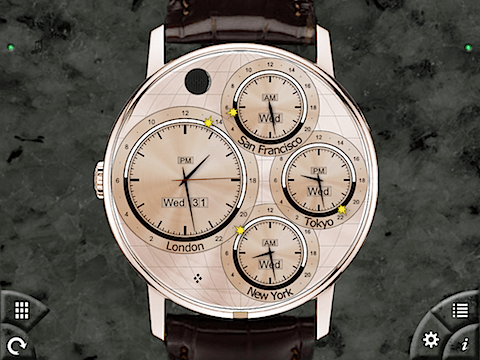
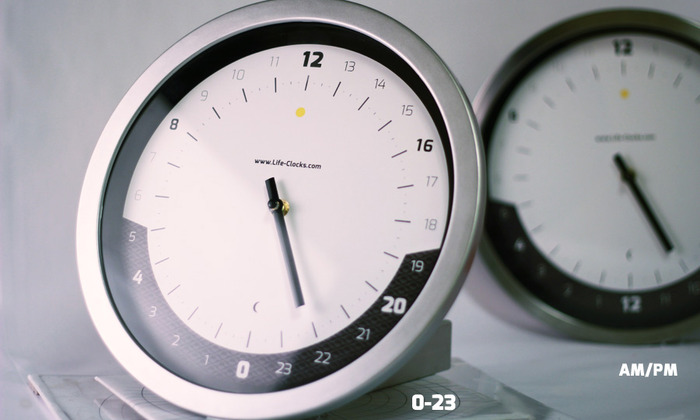
Chris Wiegman has set up a Kickstarter campaign to build 24 hour clocks. There’s already an iPhone app, with iPad and Android apps to follow if the campaign is successful.


The basic idea seems to be that you can customize the clock with your activity schedule, around the outside, seeing at a glance how the different activities during the day are organized. This is one of the helpful aspects of the 24 hour dial – we’ve heard from Sylvie about her work in Sweden with the Pajala Klockan.  And the clock designed for Saffron allows you to change the length of the night and day sections.

On the app version, you can change the labelling and colours for the various sectors, or switch between various presets.


For more information about the Life-Clocks project, visit http://www.life-clocks.com.

Train interval indicators

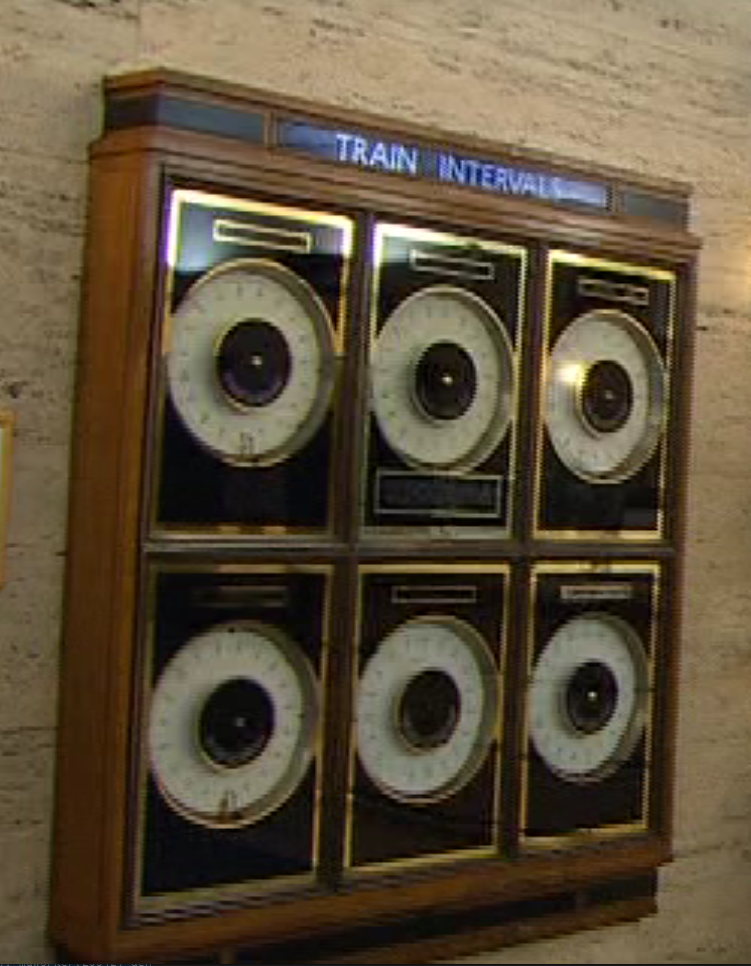
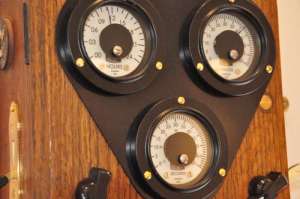
These 24 hour train indicator dials are apparently still to be found in the entrance lobby of the headquarters of the London Underground, at 55 Broadway. They featured in David Heathcote’s TV program looking at London’s 1920s Art Deco heritage, shown recently on on BBC 4.
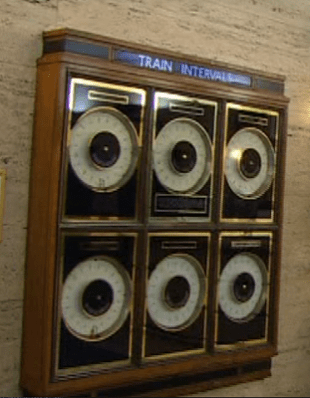
There’s a separate indicator for each of six main lines running when the building was first opened. It’s possible that one of them is still running today.
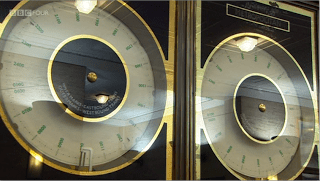
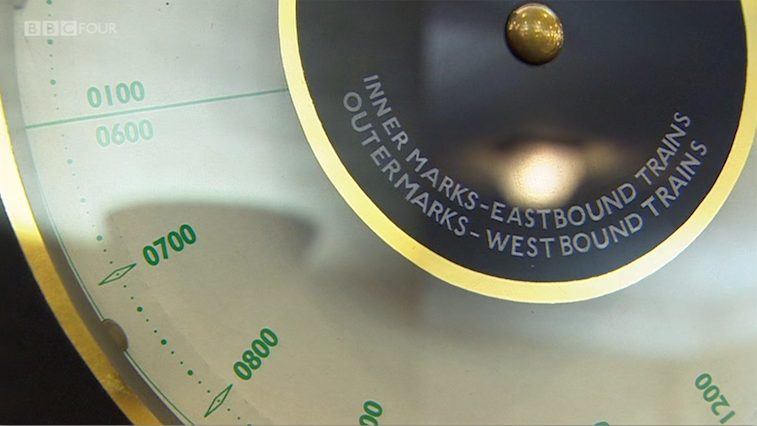
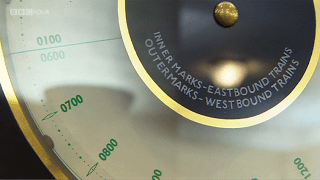
Each dial starts at 0600 and runs until 0100, passing through 2400 on the way, and appear to rotate clockwise, past an indicator at the bottom. How they actually indicate the trains is not clear —if anyone knows, please tell us!


Such a modern look wouldn’t be surprising, of course, since Frank Pick had just become managing director of what is now called London Underground. Frank Pick’s preference for the 24 hour time system can be seen in this letter to the London Times, on May 4, 1931:

UNDERGROUND PREPARED FOR ACCEPTANCE
TO THE EDITOR OF THE TIMES
Sir,– I note that on Wednesday next Lord Newton is to move in the House of Lords for the adoption of the 24-hour clock recommended by the Home Office Committee as far back as 1919. 

To the general inconvenience, we still proceed to reckon time, not by days, but by half-days. This is, perhaps, forced upon our attention most in railway time- tables, for railways run continuously round and round the clock, and in international broadcasting programmes where all times of the day become one time. 

The Underground day, although it has defined limits, is odd, starting about 5 a.m. and closing about 1 a.m., some 20 hours later. Numerous devices of type and symbol are employed for distinguishing anti- and post-meridional time, but they are often uncertain and sometimes clumsy. It would therefore be a gain if the convention of the 24-hour clock, covering the entire day, were commonly adopted so that 2.30 a.m. would be plain 2.30 and 2.30 p.m. would become 14.30.  

On the Underground Railways we should be prepared to make the change. Certainly the transit of the sun across the meridian has no visible significance underground.
For one, however, to change is only a gesture, and has its awkward reactions. If all who use time for time-tables were to change, then we should have rationalized one further detail of living. 

Yours faithfully, 

FRANK PICK. 

55, Broadway, Westminster, S.W.1

and again on 7 December 1933:

Sir,–I note the Astronomer Royal’s letter in The Times of December 2. 

As it happens, the London Passenger Transport Board has to consider the reprinting of its time-tables for its railway and coach services, and the problem of distinguishing between a.m. and p.m. once more arises. It seems strange that there should be any reluctance to adopt a proposal which has been found necessary in all those spheres of activity in which exactitude is essential. 

That there is a need for a solution of the problem must be apparent to anyone who studies time-tables. For it will be found that all kinds of typographical devices are used in an attempt to avoid any confusion between a.m. times and p.m. times. 

I therefore once more urge that we should now adopt a common practice in this matter. Once it is adopted and made a common practice,no more, I am sure, will be heard in criticism of it. 

Yours faithfully,  

FRANK PICK. 

55, Broadway, Westminster, S.W. 1

More details of how Britain tried and failed to adopt the 24 hour clock can be found in the ebook: Counting Time.
Mr. Jones Satellite 24 Hour Mystery Dial Limited Edition

From Watchismo comes news of the wonderfully-named Mr. Jones Satellite 24 Hour Mystery Dial Limited Edition watch.


Satellite is the first 24 hour watch from Mr. Jones, which means the hour hand makes one complete revolution of the dial in 24 hours.  The watch has an unconventional arrangement of hour and minute hands: the slow moving hour marker sits outside the the minutes.  This was inspired by the movement of celestial bodies: the more distant a planet is from the center of gravity the longer its orbit takes.  

Each hour is marked by a bright color and these colors follow a regular six hour pattern, so you can learn to read the time intuitively and at a glance.


However, this is a limited edition – only 100 pieces made – so if you want one, hurry up!

24-hour clocks for kids

Timely idea wakes up a new venture

(a news item printed in the Birmingham Post, May 8 2002)

Night after night Mark and Taryn Freemantle faced the same torture.
Come 4am, without fail, they would find themselves abruptly wrenched out of their peaceful slumber.
There, standing at the edge of the bed would be – horror of horrors – their two-year-old daughter Saffron, ready to start the day.
Anyone who has suffered the nightly sleep interruption faced by new parents will sympathise with the Freemantles.
As young professionals struggling to hold down demanding jobs, not getting a good night’s kip can be devastating, undermining one’s performance at work and making domestic life far from bliss.
Mark, however, decided to do something to end the nightmare. He put to use his university training as a product design degree student to invent what he believes is the world’s first clock that helps children sleep.

“I was racking my brains to find ways to get my daughter to stay in her bed,”

said the 38 year-old who works as a commercial manager in the automotive sector.

“She would wake up at 4am and wouldn’t understand she needed to wait another three hours before we woke up. We tried having a light that switched on in the morning, but if she woke up and the light wasn’t on she got very frustrated.”
“The trouble is most children cannot tell the time until they are over five years old and struggle to read numbers.” 

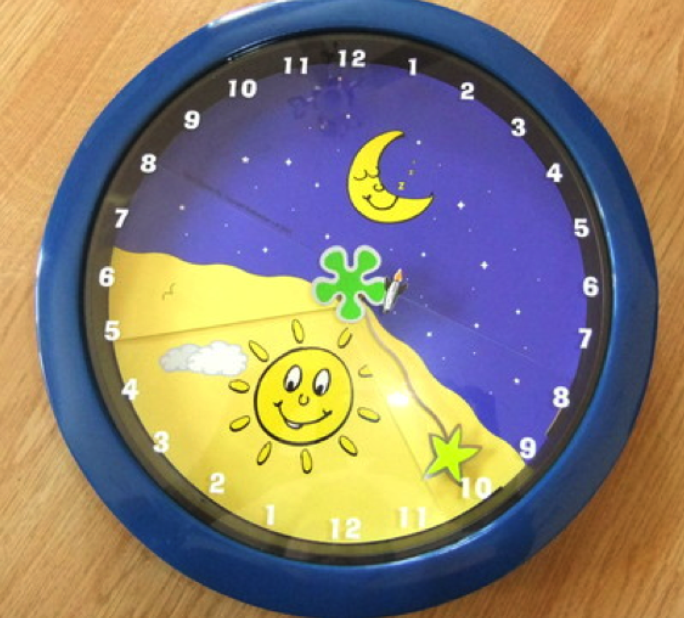
Mark decided what was needed was something that clearly showed the difference between night and day in a way that children could understand.
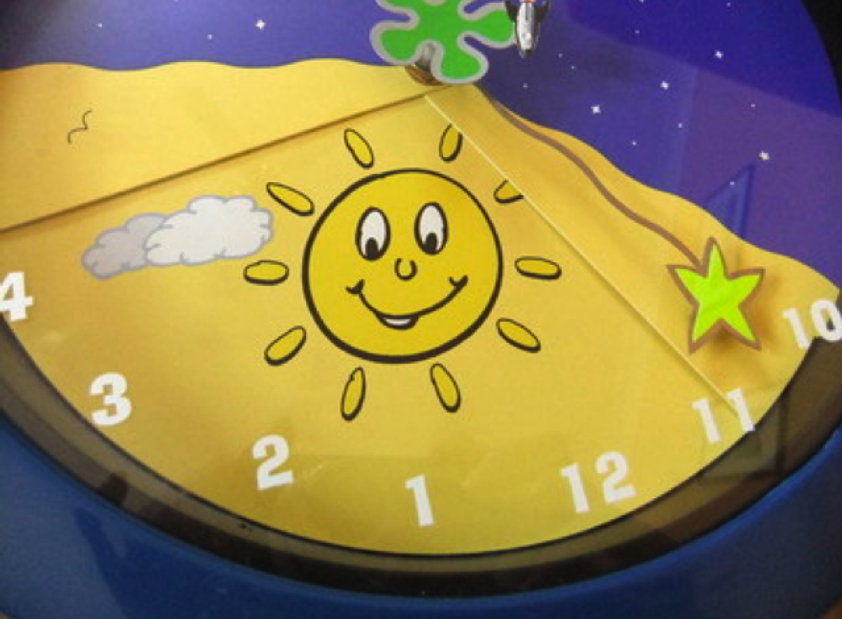
So, he cobbled together a number of clock parts to make a 24-hour one that split the face into a yellow-coloured day section and a dark blue night section. The difference between night and day was clearly indicated by the position of a star-tipped hour hand. To finish off, Mark gave the clock a mechanism, allowing parents to adjust the size of the night and day period. 

“I thought if my daughter could visually see how long she had to wait before getting up and get a sense of time, it would help,” 

said Mark.

“It needed to be very pictorial for young children to understand.”

The clock worked a treat and little Saffron stayed in her own bed giving the Freemantles the greatest gift known to parents – uninterrupted sleep.

Emerald Chronometer

Emerald Chronometer HD is a watch simulator app for the iPad made by Emerald Sequoia. (There’s an iPhone version too, called Emerald Chronometer.) The app consists of fifteen watches (named after cities) created in software, with each watch offering different features on its front and rear faces.
At first glance, you might imagine that there’s not much point to simulating watches on an iPad. After all, doesn’t the iPad tell the time perfectly well, even if it doesn’t come with a built-in clock app, like its smaller brother?
But you’d be wrong: the developers of Emerald Chronometer have blended the legacy of centuries of fine watch-making craftsmanship with the latest interactive touch-screen technology to build a digital playground that lets you investigate the worlds of time-keeping and astronomy with your fingertips.
all-watches.png
Each ‘watch’ offers a different approach to time. Rather than copy existing models, the designers have created new, imaginary watches that blend features from traditional time-pieces with features that you could expect to find only on an extremely expensive watch, or a powerful computer.
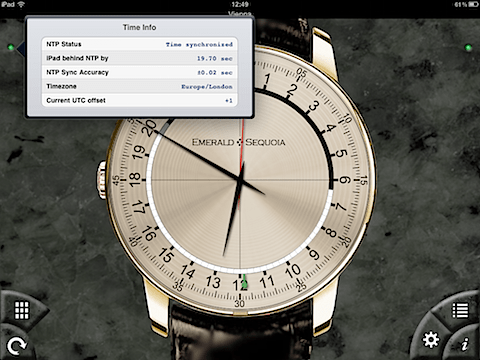
For example, the Vienna offers a traditional 24-hour display (the rear face offers a version with 12 at the top). The app synchronizes with the NTP protocol over the internet, which means that these watches almost certainly keep time more accurately than the iPad itself. I’ve clicked on the Time Synch button which pops up a display showing how far adrift my iPad is. The white, black, and grey bands on this and other watches show the current lengths of day, night, and moonlight periods.
vienna-with-ntp.png
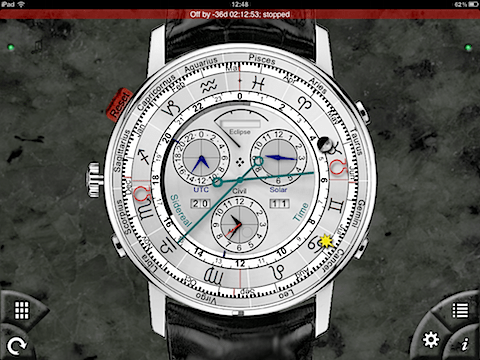
Where the Vienna is simple, the Geneva is complex. The front face shows the time as fully as possible, including years and leap years (recognizing both Julian and Greogrian calendars), sun and moon rising and setting times, and moon phase and age. The rear face shows local apparent sidereal time on a 24-hour dial, the zodiac, equinoxes, and solstices, the positions of the lunar ascending and descending nodes – even whether there’s an eclipse soon.
geneva-rear.png
But the real magic of this app is revealed when you ‘pull out’ (or tap) the crown for the current watch. The watch stops, and you can then pull and push the hands and indicators around the dial to your heart’s content. Watchmakers will find it unbearably painful to look at as you pull the hour and minute hands into different positions, or scroll the indicator dials up and down through the years with the flick of a finger. If, as you’re moving through time, there’s the possibility of an solar or lunar eclipse, the eclipse indicator at the top of the Geneva will let you know.
The Alexandria watch, named for Ptolemy’s home town, displays the time using a geocentric display; the Firenze watch, named for Galileo’s sometime home, is an orrery – a sun-centered display of the solar system. And in each case, you can drag the planets around to see how they move in space as you travel through time.
firenze.png
The Miami watch shows the rise, transit, and set times of all the planets (and the Sun and Moon), with a single hand on a 24-hour dial, and their current azimuth and altitude.
miami.png
The Terra watch specializes in time zones: the front shows your chosen zone at the top, with a 24-hour ring to help you read off the time in other cities. Again, being able to move the rings round makes it easy to explore time zones and time differences. The rear face provides four dials for your favourite cities.
terra-front.png

terra-rear.png
On the Olympia, you’ll find a stopwatch; on the Thebes, a countdown timer; and on the Istanbul, an alarm, which chimes like a traditional watch.
If you have an iPad (or an iPhone), this app is a cool and clever addition to your library, and a pleasant way to spend (and learn about) time.

History lesson: a brief history of the 24-hour clock

Although this free electronic book isn’t strictly about the 24-hour analog clock, but about the 24-hour time system, it has some relevance to the clocks and watches displayed on this site.

If you have an iPad or iPhone or iPod Touch you can download it directly onto your device into the  iBooks app from a link on this page. If you have some other kind of eBook reader, you may be able to download it if you can load ePub or PDF books. Either way, let me know!