Visit Bell Clocks to buy these quality Chelsea TimeMaster clocks.

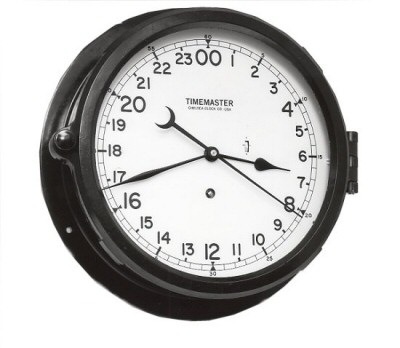
Visit Bell Clocks to buy these quality Chelsea TimeMaster clocks.
I haven’t yet managed to find any 24 hour analog screen savers, but it wasn’t too difficult to make this one for my Mac, using the Quartz Composer graphical programming environment provided with all Macs.
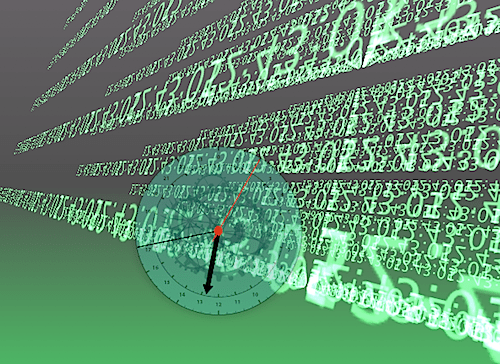
Download this from the Software page.
Here’s one of the display options provided by ActiveEarth, a software clock that runs on Windows computers:
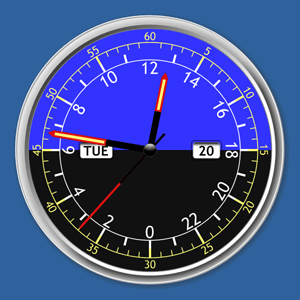
You can buy this from Active Earth.
This combined galvanometer and 24 hour clock was in the window of a shop called Hancocks, somewhere in London in the early 20th century.

It was one of many clocks that were electrically connected to London’s Greenwich Observatory. This service started in the 1850s, when Greenwich time was first provided to interested subscribers – the watchmakers, government offices, and railway operators who needed to know the exact time. In 1873, the cost of connecting your apparatus to the nearest Post Office’s time server was £12 a year.
I suppose the needle would have deflected at the start of each hour. More ingenious solutions were tried to indicate the exact moment: most popular was a ball on a pole, that descended at the start of the new hour.
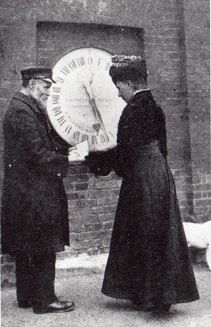
Sometimes, though, nothing can beat a personal service. This picture shows Ruth Belville, the Greenwich Time Lady. Her job was to set her accurate pocket watch at the main Greenwich Observatory 24 hour clock on a Monday morning, get a signed certificate from an official, and then walk around London visiting forty or fifty chronometer makers, who would then transfer the right time to their own most reliable timekeeper. She carried on doing this job from 1892 to the 1930s.
This morning, my computer asked one of Apple’s computers on the other side of the world for the right time, using the Network Time Protocol to set its clock, taking less than a few seconds to do it. Just some of the everyday magic that we take for granted today.
If you wanted to qualify as a master clockmaker in 17th century Augsburg (Germany), your final assignment was to make a clock with the following specifications:
A clock which shows the time both in the great and small clock ie the 24 hour and 12 hour system. It should show the times of sunrise and sunset and also show the position of the sun and moon in the zodiac throughout the year. It should strike the quarter hours and the full hours in both 1-12 and 1-24 hour systems.
You would be given about six months to make one and submit it to the examiners, the guild masters. If it was good enough, you became a master clockmaker. The examiners would be expecting something like this, perhaps:
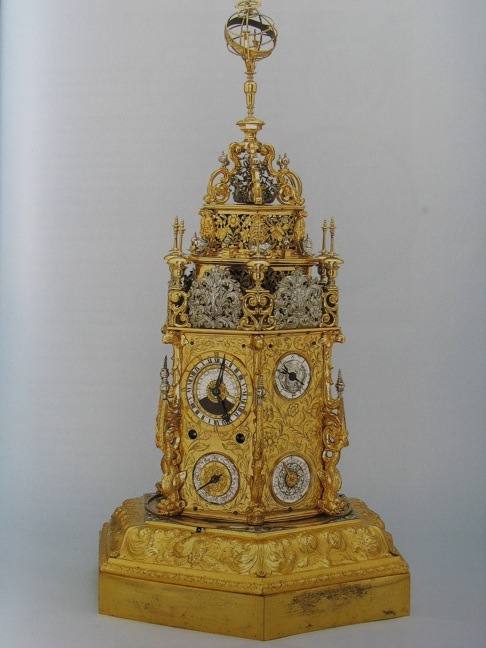
This example of a masterpiece clock organizes its myriad features around a hexagonal framework. On two faces there are main dials showing the time in the ‘Great’ (24 hour) system. On a face not visible here, there are hands showing the age and phase of the moon, and an astrolabe with sky map. The large dial shown here has five sets of numbers, and a moving sunrise/sunset/daylight indicator formed by two light and dark moving discs. Another hour hand shows either Nuremberg hours (where counting started at sunset) or Bohemian hours (where counting started at sunrise). And around the outside you can tell the time in both the Great and Small systems.
Other dials show the day of the week, and control the bell-ringing. There’s a switch to choose 24 hour or 12 hour striking, so that 13 o’clock can be indicated either by 1 or 13 chimes. And on the right dial below there’s a read-out of the current state of the count wheels for the chiming – notice how the gaps between the numbers are proportional to them, with wider gaps for the large numbers. This is the clockmaker’s ingenious solution to the task of keeping count of how many chimes to make.
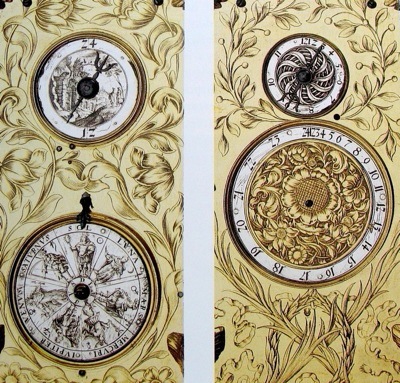
This clock’s intriguing because it provides for a number of different and conflicting time standards, even at the risk of increasing its complexity. To some extent this might be because the clock is an academic exercise, rather than a cost-effective market-ready offering, but it suggests that both Nuremberg and Bohemian hours were still in use around 1650.
I hope the maker of this example qualified!
You can see this clock in the British Museum, London. It also appears in a new book, Clocks, by David Thompson, published in 2004 by the British Museum Press. The book describes some of the treasures in the Museum’s clocks department, with many fine photographs by Saul Peckham.
Here’s an amazing new look 24 hour analog watch, designed by Kent Parks at Everest Watches.

The daylight hours are at the right side of the dial, and the nighttime hours are on the left side. It all glows in the dark, too!
I saw this on the WatchUSeek 24 hour watch forum. This is a great place to meet 24 hour watch enthusiasts and experts, and talk about 24 hour watches.
Another reason to show this watch here is that it illustrates the difference between the 24 hour dial and the 24 hour time format. The 24 hour dial shows all the hours of a day at once; the 24 hour time format (known outside the US as ISO 8601) uses the numbers 13 to 23 for afternoon and evening hours rather than AM and PM suffixes. This watch, like so many 24 hour clocks and watches from earlier centuries, uses a double-12 numbering system rather than the 24 hour time format.
Here’s a nice clock for those of you with a yacht. I think I could find a place for it in my house too.
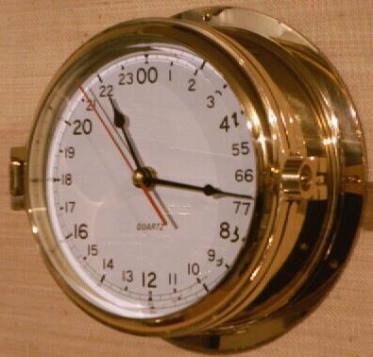
Details on the Where to buy 24h clocks page. (Thanks Francis.)
I spotted this strange clock recently, and I thought it would be fun to make it a mystery picture. Where can you see this clock? (Sorry about the quality.)
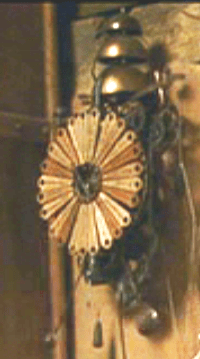
No prizes for guessing the answer, except the satisfaction of being a clock wizard!
This is a solid-looking clock for the seafarer in your life, from Chelsea Clocks.

The TimeMaster’s 8 day mechanical movement is the finest in the world, according to Chelsea Clocks, so you should expect to pay 00 for one of these. Please buy me one!
This month sees the world premiere of the opera 1984 composed by conductor Lorin Maazel, with a libretto based on the 1948 novel by George Orwell. The opera opens with the clock tower of Big Ben striking thirteen, and ends with the same idea. It’s a good way of realising the famous opening lines of the original novel:
It was a bright cold day in April, and the clocks were striking thirteen. Winston Smith, his chin nuzzled into his breast in an effort to escape the vile wind, slipped quickly through the glass doors of Victory Mansions, though not quickly enough to prevent a swirl of gritty dust from entering along with him.
I’ve often wondered about this opening reference to the 24 hour time system. The use of the unlucky number 13 contributes to the atmosphere of strangeness and grime that characterizes much of the setting for 1984. But the device is less effective for us today, since the 24 hour clock is used much more than previously.
The reference would have seemed alien and unnatural to an English reader in the 1940s, as Orwell intended. Presumably for him the 24 hour time system was associated mainly with continental Europe, and England was still recovering from a major war with quite of lot of Europeans. Orwell might also have known that the French revolutionaries in the 1790s changed the time system to 10-hour days, so naturally his theoretical Party would have imposed an alien time system on the proles. Orwell probably didn’t realise that the 24 hour dial can be traced right back to the early English medieval church’s experiments with the new-fangled clock, or to the fine English clockmaking traditions of Tompion and Harrison.
Orwell cleverly juxtaposes the strange-sounding official 24 hour time system with the friendly pre-Big Brother 12 hour system that Winston and Julia find in their hide-out:
Winston looked round the shabby little room above Mr Charrington’s shop. Beside the window the enormous bed was made up, with ragged blankets and a coverless bolster. The old-fashioned clock with the twelve-hour face was ticking away on the mantelpiece. In the corner, on the gateleg table, the glass paperweight which he had bought on his last visit gleamed softly out of the half-darkness.In the fender was a battered tin oilstove, a saucepan, and two cups, provided by Mr Charrington. Winston lit the burner and set a pan of water to boil. He had brought an envelope full of Victory Coffee and some saccharine tablets. The clock’s hands said seventeen-twenty: it was nineteen-twenty really. She was coming at nineteen-thirty….When he woke it was with the sensation of having slept for a long time, but a glance at the old-fashioned clock told him that it was only twenty-thirty. He lay dozing for a while; then the usual deep-lunged singing struck up from the yard below;
Occasionally, Orwell helps us by translating the 24 hour time system ‘back to normal’ for us:
The clock’s hands said six, meaning eighteen. They had three or four hours ahead of them. He propped the book against his knees and began reading…
But Winston Smith is pretty well indoctrinated:
The lane widened, and in a minute he came to the footpath she had told him of, a mere cattle-track which plunged between the bushes. He had no watch, but it could not be fifteen yet………He lit another lamp, and, with bowed back, led the way slowly up the steep and worn stairs and along a tiny passage, into a room which did not give on the street but looked out on a cobbled yard and a forest of chimney-pots. Winston noticed that the furniture was still arranged as though the room were meant to be lived in. There was a strip of carpet on the floor, a picture or two on the walls, and a deep, slatternly arm-chair drawn up to the fireplace. An old-fashioned glass clock with a twelve-hour face was ticking away on the mantelpiece. Under the window, and occupying nearly a quarter of the room, was an enormous bed with the mattress still on it.
This juxtaposition of 24 and 12 hour clocks for poetic effect might still work for many English and American readers, particularly those of a certain age who are less familiar with the 24 hour clock. I wonder how translations of the novel deal with the problem – perhaps convert to metric time…
 24hourtime.info