24 hour

Paris in the swing time

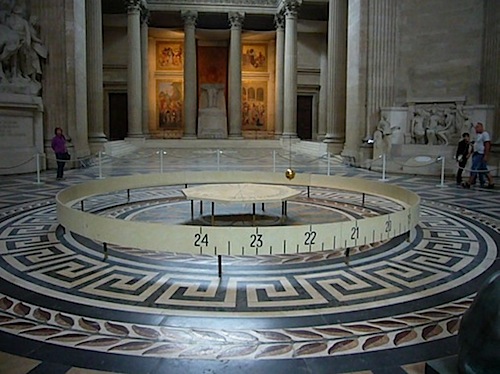
In theory this should rate as one of the biggest 24 hour clocks in the world:

foucault1.jpg

It’s Foucault’s famous Pendulum, swinging away in the Pantheon, in Paris. As you can see by the markings, it can claim to be a sort of 24 hour clock. As the earth slowly rotates underneath the swinging pendulum, you can imagine the whole building – and the rest of Paris – moving slowly counterclockwise – or to the right in this picture – with the pendulum swinging freely to and fro in space.

The theory is simple, but in practice it doesn’t make a good clock. For one thing, Paris is perched on the side of the earth at latitude 50 degrees, rather than situated at the pole, and so the top of the pendulum moves around the earth’s axis as well. At this latitude, the pendulum will rotate through about 270 degrees in one day, rather than the whole 360. Also, the pendulum will gradually stop swinging due to air resistance and friction. There’s no electro-mechanical device in the ceiling that keeps it going, so it will slow down and eventually stop anyway. The attendant in the Pantheon usually grabs the bob and releases it from the right place at the start of the day.

WorldChronos

The Twenty First Century Watch Corporation are very proud of their new watch, which is “designed for the new global society”. The inventor argues that:

Every world time watch we could find seemed to have a twenty-four hour dial with the “24” at the top of the dial. Even many Europeans confided that when they saw or heard a time in 24 hours, they mentally converted it to a 12 hour am or pm time. This was just too confusing, so we drew a circle with two sets of twelve and one 12 at the top to be the ‘Noon’ 12 and one on the bottom to be the ‘Midnight’ 12. This seemed more intuitive as the dial mimicked the appearance of the sun revolving around the earth so that at noon it is directly overhead and at midnight it is directly under us.

world chronos

He’s discovered the old medieval Double-XII system again.

The price is about $2000.

The world as seen from Paris in 1800

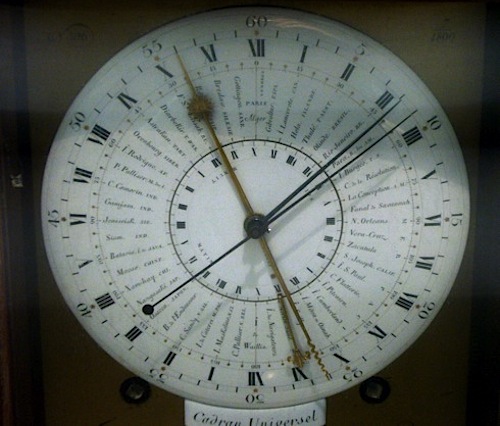
In the Musée des arts et métiers in Paris you can see this clock, a Cadran Universel made by Janvier in 1800:

janviercadran.jpg

This has a fixed outer dial containing a series of towns and cities around the world, arranged according to their longitude. Paris is at the top at 0 degrees (and London has been squeezed in as small as possible just above it and to the right, not yet at 0 degrees longitude!).

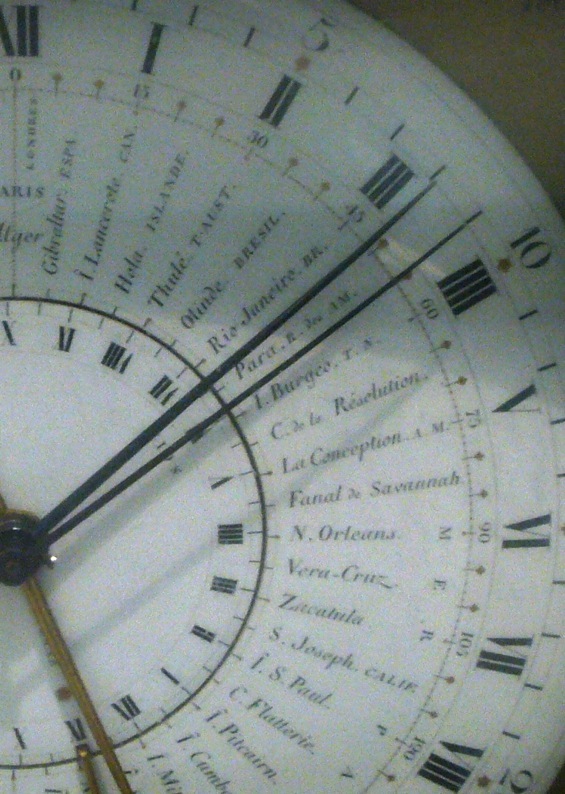
This circular list of geographic locations gives an intriguing picture of the world as seen from Paris in 1800. I’ve put together a quick list of a few of the places mentioned, with the Paris-based and my estimates of the London-based longitudes, to see how many can be identified:

janviercadran2.jpg

7.5 (5.5) Gibraltar ESPA – Gibraltar
15.0 (13.0) I Lancerote Can. – Lanzarote
22.5 (20.5) Hola ISLANDE – ?
30.0 (28.0) Thule T’AUST – Thule Islan (Morrell Island) in South Sandwich Islands
37.5 (35.5) Olinde Bresil – Olinda, Brazil
45.0 (43.0) Rio Janeiro Br
52.5 (50.5) Para ?? AM.
60.0 (58.0) I Burgeo – Bridgetown, Barbados
67.5 (65.5) C de la Reselution
75.0 (73.0) La Conception A M
82.5 (80.5) Fanal & Savanna
90.0 (88.0) N Orleans
97.5 (95.5) Vera-Cruz
105.0 (103.0) Zacalula ? Tamazula in Mexico?
112.5 (110.5) S Joseph CALIF – San Jose ?
120.0 (118.0) I. S. Paul
127.5 (125.5) C. Flatterie – Cape Flatterie, near Seattle
135.0 (133.0) I Pitcairn – Pitcairn Island
142.5 (140.5) I Cumberland
150.0 (148.0) I Milea . Ounab
157.5 (155.5) ? – obscured by the hands
165.0 (163.0) ? – obscured by the hands
172.5 (170.5) I de Navigateurs

Conspicuous by their absence are most of the major US cities. In 1800, these were either unimportant or deliberately ignored, apart from New Orleans and Savannah.

Revolutions in time

If you’re visiting Paris, a good place to see some interesting clocks is the Musée des arts et métiers.

In 1793, the Revolutionary Government in France decreed that the day should be divided into 10 hours of 100 minutes, and the year into 10 months of 30 days. For a few years, clock and watch makers designed some unusual pieces to help the population learn and adopt to the new decimal time system. Here’s a good example:

frenchrevo1.jpg

The single long hand with a circle at one end and a point at the other probably shows the hours in both old and new systems. One end points to the decimal time, with 10 (0) being midnight, and 5 being midday, the other end to the equivalent old-style time. Presumably, therefore, old-style midnight (XII) is at the bottom of the dial, so that the other end can point to 10 (0). 1 o’clock (decimal) is about 02:20 old style, and the position of the hour hand in this photograph suggests that the time is 0.90 (d), or 02:10 old style.

If the other brass hand is the new minute hand, it shows 80 decimal minutes past 0. In theory a time of 0.80 (d) corresponds with about 01:55, so perhaps the hands are not quite adjusted correctly – or my assumptions are incorrect.

The grey pointer indicates the calendar day – the 12th. Every day in the new Revolutionary calendar had a object or plant associated with it, so if the current month had been Pluviôse (Jan 20 ~ Feb 18), today would be Broccoli day. (For a full list, see here.)

Here’s a watch with, I expect, midnight at the bottom:

frenchrevo2.jpg

At about 3 o’clock (decimal), or 07:15, it’s time for croissants and café. Again it’s not clear whether the minute hand is showing old or new minutes.

This next example is more radical. Only half the dial is organized for the new decimal time, the other half is defiantly quadrovigesimal (duodecimal times two):  Presumably the long dual-purpose hour hand is used again here, but I’m puzzled as to why only the roman numerals I to V are used – converting to a new time format is hard enough without having to add 5 to the hour after midday. The shorter hand pointing to the 12 might be another old-style hour hand (how could it work?), but the other hand pointing to the 2 could be an old or new style minute hand. Some more research is needed.

frenchrevo3.jpg

Intriguingly, the museum shows only 10% of its holdings at a time, with the remaining items held in a big storage facility on the outskirts of Paris.

If you can’t get to this great museum in person – to see these and other wonderful scientific objects from the past (and to eat in the excellent cafe) – the museum’s web site is worth a look.

Yahoo widget

It’s good to see someone else making 24 hour widgets. This is Max Emerson’s Yahoo widget (I think Konfabulator was bought by Yahoo and turned into Yahoo Widgets). It looks a bit more professional than my first version but I think it still needs some work – those hour lines look uneven to me:

yahoo widget

But keep them coming!

Hall of Shame: First award to Lidl supermarkets

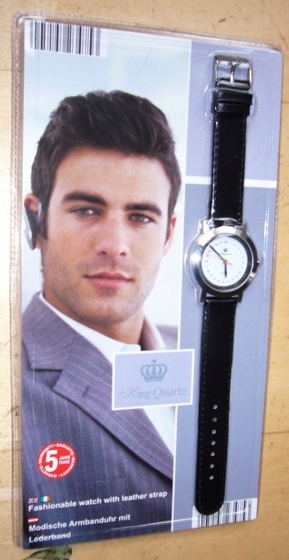
You might be surprised – and delighted – to see a 24 hour analog watch in your local supermarket while shopping. Here’s the watch in its original packaging, seen in supermarket chain Lidl this week. Looks like a bargain for just 2.99 pounds (4.5 Euros, or 6 US dollars)?

lidl1.jpg

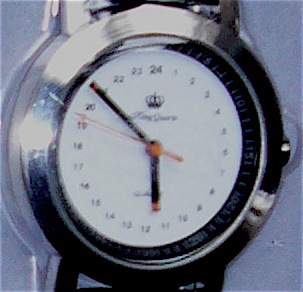
On closer inspection it promises to be a nicely-designed yet very cheap quartz genuine 24 hour analog watch:

lidl2.jpg

But it turns out that these watches have a standard 12 hour movement. So after just one hour, the hour hand has advanced two hours. Time will really fly by!

Don’t be tempted.

Chromachron screensaver

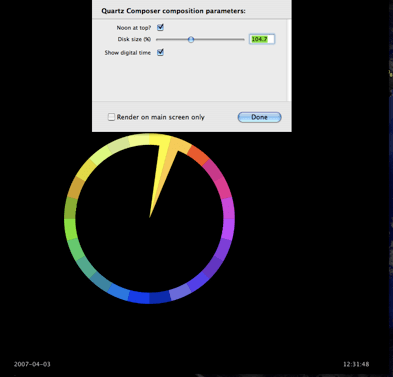
This screensaver is a version of a fascinating watch designed in the early 1970s by engineer and designer Tian Harlan. I’ve made a 24 hour analog version as a screensaver for MacOS X, using Quartz Composer.

chromachronsaver.png

The Chromachron time display method was invented by artist and designer Kristian Harlan in the 1970s. ‘Tian’ Harlan was born in Berlin, in 1939. He studied Architecture in Berlin and became a qualified engineer. In 1972 he designed the Color Time sculpture for the Olympics Games in Munich. In 1973 he released the first Colour-Time graphics and objects. The Colour-Time watch, which had a mechanical movement, was manufactured by Chromachron A.G. in Germany.

On a Chromachron device, the time is indicated by the color and angle of a slit in a rotating disc. Beneath the disc the circle is divided into 24 sections (in the original 12 hour version, the disk was divided into 12 sections). Time is indicated both by the color of a slit in a revolving disk, and by the angle of the slit (similar to the hour hand of a conventional clock). The disc revolves at the speed of one coloured segment per hour, so that it is not possible to read the exact time: five minutes before twelve is read as a short time before yellow. This approximate time measurement system was described as ‘ending the dictatorship of the exact time’. In total, Harlan designed approximately one hundred different watches. His work has been exhibited in Berlin, London, Amsterdam and Paris. It’s said that his Colour-Time watches were worn by, amongst others, Ringo Star, Max Bill, Charles Aznavour, and Carlo Levi.

More about the Chromachron here:

Java applet version of Chromachron

gchrom, a Chromachron software clock for X GNOME

Chromachron for windows

I’ve finally managed to work out how to add some options, so there’s a noon at the top option, a digital readout, and a way of adjusting the thickness of the coloured rim.

Put the contents of the Zip archive in your screensavers folder. You can edit this file in Quartz Composer. If you make any interesting improvements, let me know!

Download (MacOS X only)

Eclipse widget

Software people don’t always provide a 24 hour analog clock widget in their applications, but it’s a good idea – if only because it spares users who don’t like AM/PM having to specify times using these options. Here’s a more enlightened developer – Jeremy Dowdall – who has designed the Nebula CDateTime widget for Eclipse:

.eclipse.png

It looks to me like it would be much easier to set the time using this widget than a 12-hour widget. What do you think?