I’ve been updating this website – to make it easier to manage. Please let me know of any errors or problems you experience.
Yahoo widget
It’s good to see someone else making 24 hour widgets. This is Max Emerson’s Yahoo widget (I think Konfabulator was bought by Yahoo and turned into Yahoo Widgets). It looks a bit more professional than my first version but I think it still needs some work – those hour lines look uneven to me:

But keep them coming!
Hall of Shame: First award to Lidl supermarkets
You might be surprised – and delighted – to see a 24 hour analog watch in your local supermarket while shopping. Here’s the watch in its original packaging, seen in supermarket chain Lidl this week. Looks like a bargain for just 2.99 pounds (4.5 Euros, or 6 US dollars)?
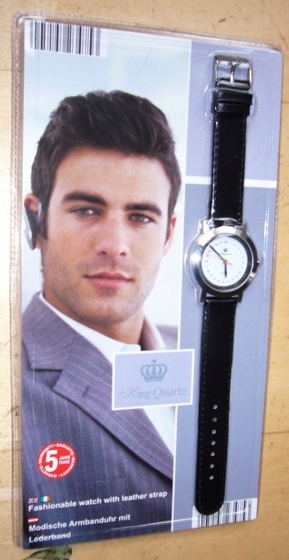
On closer inspection it promises to be a nicely-designed yet very cheap quartz genuine 24 hour analog watch:
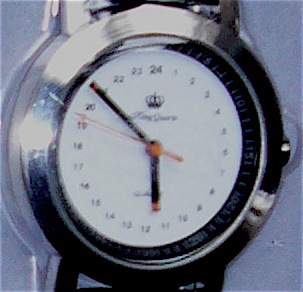
But it turns out that these watches have a standard 12 hour movement. So after just one hour, the hour hand has advanced two hours. Time will really fly by!
Don’t be tempted.
Chromachron screensaver
This screensaver is a version of a fascinating watch designed in the early 1970s by engineer and designer Tian Harlan. I’ve made a 24 hour analog version as a screensaver for MacOS X, using Quartz Composer.
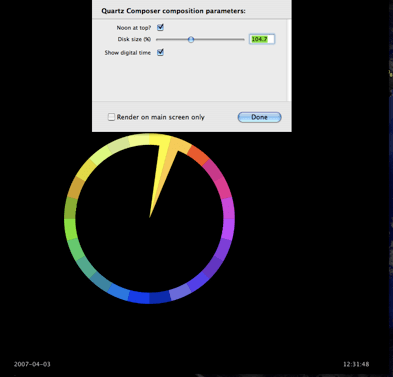
The Chromachron time display method was invented by artist and designer Kristian Harlan in the 1970s. ‘Tian’ Harlan was born in Berlin, in 1939. He studied Architecture in Berlin and became a qualified engineer. In 1972 he designed the Color Time sculpture for the Olympics Games in Munich. In 1973 he released the first Colour-Time graphics and objects. The Colour-Time watch, which had a mechanical movement, was manufactured by Chromachron A.G. in Germany.
On a Chromachron device, the time is indicated by the color and angle of a slit in a rotating disc. Beneath the disc the circle is divided into 24 sections (in the original 12 hour version, the disk was divided into 12 sections). Time is indicated both by the color of a slit in a revolving disk, and by the angle of the slit (similar to the hour hand of a conventional clock). The disc revolves at the speed of one coloured segment per hour, so that it is not possible to read the exact time: five minutes before twelve is read as a short time before yellow. This approximate time measurement system was described as ‘ending the dictatorship of the exact time’. In total, Harlan designed approximately one hundred different watches. His work has been exhibited in Berlin, London, Amsterdam and Paris. It’s said that his Colour-Time watches were worn by, amongst others, Ringo Star, Max Bill, Charles Aznavour, and Carlo Levi.
More about the Chromachron here:
Java applet version of Chromachron
gchrom, a Chromachron software clock for X GNOME
I’ve finally managed to work out how to add some options, so there’s a noon at the top option, a digital readout, and a way of adjusting the thickness of the coloured rim.
Put the contents of the Zip archive in your screensavers folder. You can edit this file in Quartz Composer. If you make any interesting improvements, let me know!
Download (MacOS X only)
Eclipse widget
Software people don’t always provide a 24 hour analog clock widget in their applications, but it’s a good idea – if only because it spares users who don’t like AM/PM having to specify times using these options. Here’s a more enlightened developer – Jeremy Dowdall – who has designed the Nebula CDateTime widget for Eclipse:
.
It looks to me like it would be much easier to set the time using this widget than a 12-hour widget. What do you think?
Atomic clocks
My Norwegian correspondent Tommy Toverud sent me some interesting links, including these to the Museum of Time and Frequency. This has a strange retro-feel to it – ‘atomic clock’ still sounds modern to me – but these are cool old new things.
I’ve borrowed a picture from the site. This is a picture of a General Radio Syncronometer model 1103-A
.
And this collection of Soviet space clocks is quite impressive.
Curitiba, Brazil
In Curitiba, Brazil, you can see this clock, apparently in the street called The Street of 24 hours. These pictures were taken by Morio, who kindly uploaded them to the Wikimedia Commons.

I’m a bit puzzled by this picture – it seems to be not far from midnight…

2007 calendar
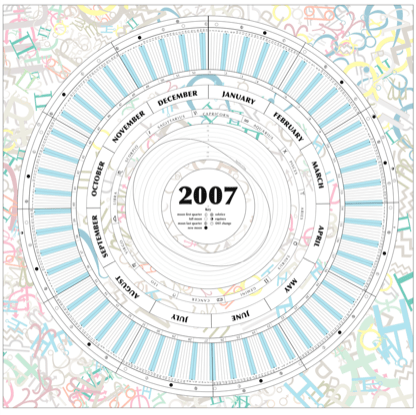
Another year, another calendar – here’s an updated version of my circular calendar for 2007. You can download this in PDF form from the Design page of this site.
Ahoy there
Just released by the nice folks at Bell Clocks is this excellent series of sailor-friendly 24 hour clocks.
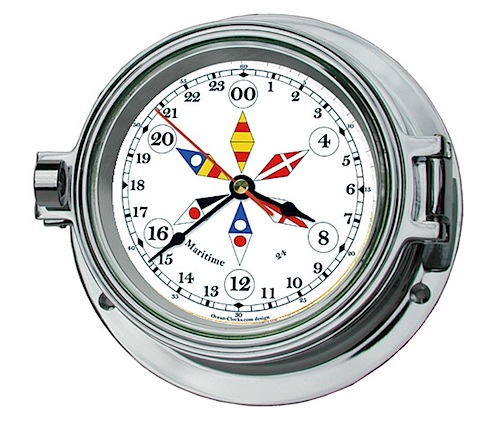
The flags on the dial indicate the traditional 4 hour watches, using the flag code.
I’m fond of this chrome look, but there are also brass models.
Greenwich time
This screensaver is a reasonably accurate simulation of the famous Shepherd clock at Greenwich in London. If you have a Mac, you can download it from this site. See the Software page on this site, or download it from this link.
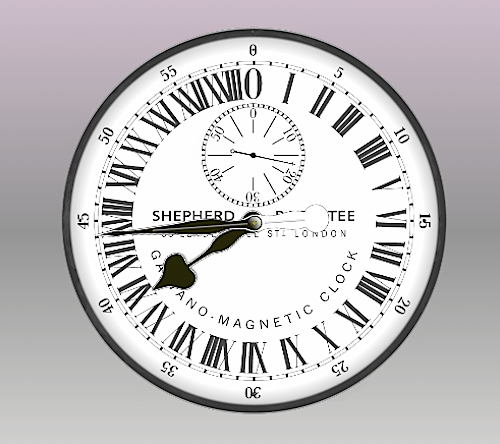
In 1852 Charles Shepherd installed a new clock outside the gate of the Royal Observatory at Greenwich. This was an electrically operated clock, one of the earliest ever made, and it was controlled by a master clock mechanism inside the main building.
While Shepherd provided the engineering know-how, the original idea had come from the Astronomer Royal, George Airy. With the arrival of the railway network, England had recently found that a single time standard was needed to replace the various incompatible local times then in use across the country. Airy decided that this standard time would be provided by the Royal Observatory. His idea was to use what he called ‘galvanism’ or electric signalling to transmit time pulses from Greenwich to slave clocks throughout the country. The new submarine cable recently installed between Dover to Calais in 1851 raised the possibility of sending time signals almost instantly between England and France – this would allow longitude differences to be measured very accurately, for the first time.
In September 1851, Airy wrote to Shepherd asking for proposals and estimates. He included a request for the following clocks:
One automatic clock. One clock with large dial to be seen by the Public, near the Observatory entrance, and three smaller clocks, all to be moved sympathetically with the automatic clock.
He also wanted the Greenwich time ball to be electrically operated, so that it would drop down its flagpole at exactly 13:00.
By August 1852, Shepherd had built and installed the network of clocks and cables in the observatory, although the costs were considerably higher than the original estimates. Shortly after, for the first time, Greenwich mean time was transmitted along cables from Greenwich to London Bridge, and thence to clocks and receivers throughout England. The primary pulse originated from this unlikely-looking master clock in the observatory.
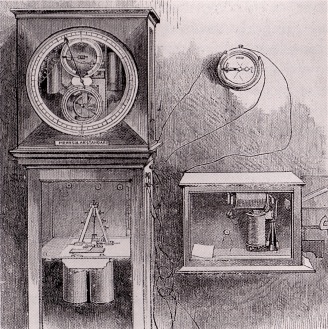
By 1866, time signals were sent from this clock to Harvard University in Cambridge, Massachusetts via the new transatlantic submarine cable.
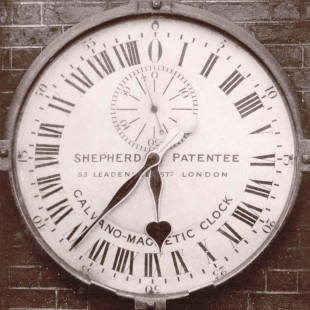
The public clock at the gate originally indicated astronomical time, in which the counting of the 24 hours of a day started at noon every day rather than midnight.
This photograph was taken in the 1870s, and shows the clock approaching midday, at the astronomical time of 23:20.
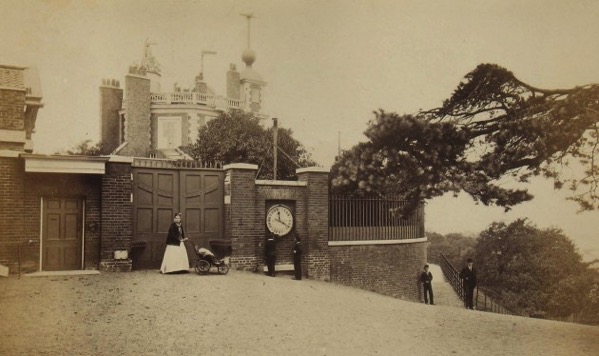
A similar photograph, from 1870, shows the clock early in the morning, with the dial showing 18:52. The clock faces east, and the sun is high up to the north east (early morning). Obviously at midday astronomers can precisely observe the sun crossing the meridian so as to set or reset a clock. The 0 here means “start counting again”.

Following the International Meridian Conference, the clock was altered to show civil time with effect from 1 January 1885. Ever since, it’s shown Greenwich Mean Time, rather than British Summer Time (Daylight Saving Time).
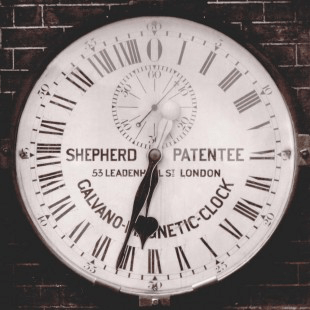
The dial has seen numerous minor design changes over the years:
The original:
After a (not very successful) 1910 repainting:
In 1940, a bomb destroyed the gates and damaged the dial. In 1947 a new replacement dial was installed:

The 1981 repainting thankfully reverted to an exact copy of the original design:
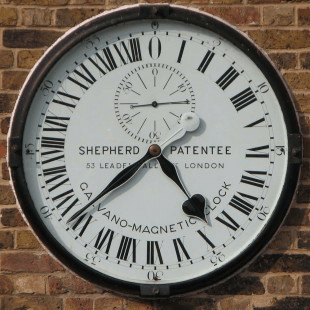
The clock is still ticking happily away today, although it’s now controlled by a quartz mechanism inside the main building. Here’s one of thousands of recent photographs:

The master clocks are still on display, as are the famous series of chronometers made by John Harrison. In the shop you can buy postcards and lapel pins of the clock (but no fridge magnets!) and there’s also a small 24 hour quartz clock on sale. It’s like a replica, although the complexities of the original Shepherd design have been replaced by a simpler interpretation.
When attempting my own version of this clock, the hardest parts were definitely the roman numerals. I couldn’t find any font which matched and had to draw them again from scratch. If you compare my copy and the original you’ll notice how much better the original is. Many subtle variations in size and placement were employed to produce an acceptable solution to an intractable problem: how to make numbers of such different widths do the same job. It’s not a pretty design, I have to say, but it has a good solid Victorian heaviness to it, which matches its history well.
For even more information about the clock, refer to this article on the Royal Observatory Greenwich website.
 24hourtime.info
