If you wanted to qualify as a master clockmaker in 17th century Augsburg (Germany), your final assignment was to make a clock with the following specifications:
A clock which shows the time both in the great and small clock ie the 24 hour and 12 hour system. It should show the times of sunrise and sunset and also show the position of the sun and moon in the zodiac throughout the year. It should strike the quarter hours and the full hours in both 1-12 and 1-24 hour systems.
You would be given about six months to make one and submit it to the examiners, the guild masters. If it was good enough, you became a master clockmaker. The examiners would be expecting something like this, perhaps:
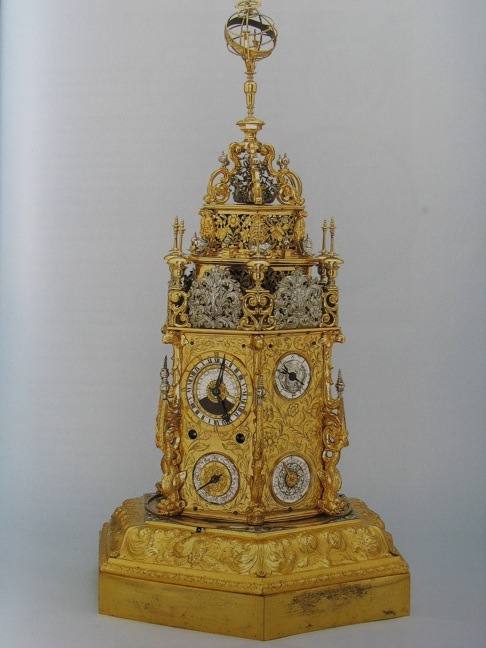
This example of a masterpiece clock organizes its myriad features around a hexagonal framework. On two faces there are main dials showing the time in the ‘Great’ (24 hour) system. On a face not visible here, there are hands showing the age and phase of the moon, and an astrolabe with sky map. The large dial shown here has five sets of numbers, and a moving sunrise/sunset/daylight indicator formed by two light and dark moving discs. Another hour hand shows either Nuremberg hours (where counting started at sunset) or Bohemian hours (where counting started at sunrise). And around the outside you can tell the time in both the Great and Small systems.
Other dials show the day of the week, and control the bell-ringing. There’s a switch to choose 24 hour or 12 hour striking, so that 13 o’clock can be indicated either by 1 or 13 chimes. And on the right dial below there’s a read-out of the current state of the count wheels for the chiming – notice how the gaps between the numbers are proportional to them, with wider gaps for the large numbers. This is the clockmaker’s ingenious solution to the task of keeping count of how many chimes to make.
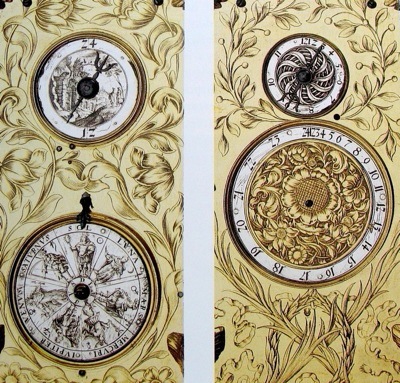
This clock’s intriguing because it provides for a number of different and conflicting time standards, even at the risk of increasing its complexity. To some extent this might be because the clock is an academic exercise, rather than a cost-effective market-ready offering, but it suggests that both Nuremberg and Bohemian hours were still in use around 1650.
I hope the maker of this example qualified!
You can see this clock in the British Museum, London. It also appears in a new book, Clocks, by David Thompson, published in 2004 by the British Museum Press. The book describes some of the treasures in the Museum’s clocks department, with many fine photographs by Saul Peckham.




 24hourtime.info